
Primary Biomechanical Hardware & Intelligent Software
Explore our flagship field-calibrated inertial measurement sensor suits, precision hand gloves, and algorithmic analysis packages deployed across research, industry, and teleoperation.


The Paradigm Shift in Full-Body Biomechanical Measurement
From optical laboratory confines to untethered in-situ telemetry: how 9-axis IMU fusion and edge computation redefine quantitative kinematics across Fortune 500 enterprises and research consortiums.
$1.85B Global Market Dynamic
The global biomechanical analysis and wearable motion tracking sector is experiencing a compound annual growth rate (CAGR) of 14.8% through 2030. Driven by non-invasive musculoskeletal diagnostics, ergonomic automation audits, and embodied AI datasets, procurement demand is rapidly shifting from fragile optical stages to robust wearable IMU telemetry suits.
- Overcoming laboratory spatial boundaries
- High-frequency real-world kinematics capture
- Direct integration into neural training loops
Elimination of Optical Line-of-Sight Occlusion
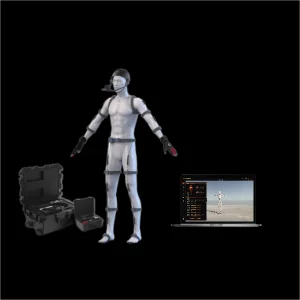
Conventional multi-camera optical motion capture relies on uninterrupted retroreflective sightlines. In confined ergonomic workspaces, aerospace cockpits, or contact sports, optical occlusion creates catastrophic data gaps. Advanced biomechanical analysis suits like the VDSuit Full solve this using body-conformal inertial sensor networks.
- Zero data fallout during complex postures
- Untethered outdoor & heavy-equipment testing
- Multi-actor simultaneous spatial evaluation
Embodied AI & Robotics Convergence
The explosive rise of humanoid robotics has transformed motion capture from an entertainment animation tool into an indispensable training infrastructure. Human demonstrations captured via biomechanical sensor suits provide high-fidelity multi-joint trajectories, enabling imitation learning, teleoperation, and reinforcement learning in simulation platforms.
- Millisecond-level real-time robot control
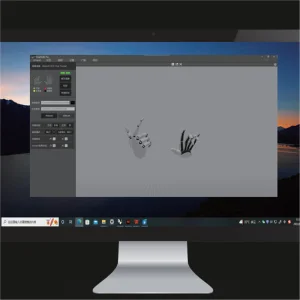
- Synchronized finger dexterity via mHand Pro
- Native ROS, ROS2, and URDF kinematic mapping
China Manufacturing Superclusters & Cost-Performance Multipliers
How Guangzhou Virdyn leverages Greater Bay Area hardware clusters, automated multi-axis turntable calibration, and direct OEM/ODM agility to lower institutional procurement barriers.
Zero 3rd party black-box algorithmic dependencies.
Ultra-fast real-time transmission & retargeting.
Drastic reduction in global procurement capital expenditure.
Direct engineering tier-1 troubleshooting.
Automated Tri-Axial Turntable Calibration System
Unlike assembled commercial kits relying on software zero-point guesswork, every Virdyn MEMS node undergoes rigorous 3D spatial rotation on multi-axis automated turntables. This thermal-mechanical profiling eliminates manufacturing bias, reduces orthogonal drift, and guarantees precision alignment within 0.05 degrees per sensor across wide operating temperatures.
By conducting continuous calibration within our Guangzhou advanced manufacturing base, institutional clients in clinical medicine and aerospace receive factory-validated sensor nodes with traceable verification records.
Agile Hardware-Firmware Iteration & Customization
Benefiting from the world's most dense electronics supply chain ecosystem in Southern China, Virdyn accelerates the prototype-to-production lifecycle by up to 400% compared to European or North American competitors. Custom strap geometries, anti-static medical textile fabrics, specialized sensor hub form factors, and unique wireless band adaptations are implemented rapidly.
Global procurement teams can request tailor-made OEM/ODM SDK interfaces, specific cable harnesses, and industrial environmental hardening without incurring prohibitively high NRE (Non-Recurring Engineering) expenses.
Inside Virdyn's Tri-Layer Data Processing Engine
A look into how 9-axis sensor fusion, adaptive Kalman filtering, and biomechanical anatomical constraints prevent magnetic drift and spatial displacement degradation.
Layer 1: Edge MEMS Filtering
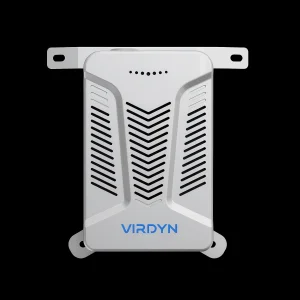
Each independent node combines tri-axial accelerometers, high-bandwidth gyroscopes, and solid-state magnetometers. Sampling occurs internally at up to 1000 Hz, with ultra-low latency on-chip preprocessing executing noise gate cutoffs, high-g acceleration buffering, and temperature normalization before wireless transmission.
Layer 2: Adaptive Multi-Sensor Fusion
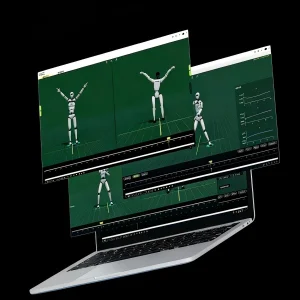
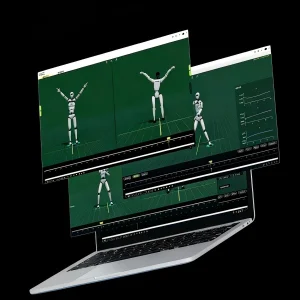
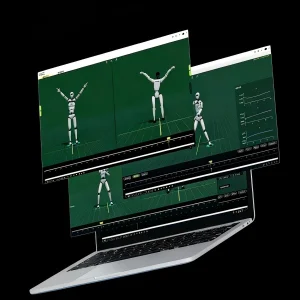
Running within VDMocap Studio Plus, Virdyn's Extended Kalman Filter (EKF) intelligently evaluates local magnetic field perturbations. When environmental ferromagnetism is detected, the algorithm temporarily decouples yaw reliance from the magnetometer, preserving postural continuity without drift spikes or joint inversions.
Layer 3: Kinematic Rig Rigidity
The biomechanical solver applies physiological range-of-motion (ROM) constraints, rigid-body segment length locks, and foot-floor zero-velocity contact constraints (ZUPT). This guarantees that extracted data reflects actual skeletal kinematics, ensuring pristine foot plants without visual skating or disjointed bones.
Kinematic Sensor Architecture Matrix
| Technical Parameter | Virdyn Inertial Suit System (VDSuit Full) | Traditional Optical Marker Rig | Standard Single-Camera AI Vision |
|---|---|---|---|
| Degrees of Freedom (DOF) | Full 6-DOF Skeletal Tracking with Joint Angular Kinematics | 6-DOF Position with Calculated Angular Arrays | Approximated 2.5D / Estimated Pseudo 3D |
| Environmental Occlusion Sensitivity | Completely Immune (Wearable direct MEMS telemetry) | Severe vulnerability to obstruction & marker dropout | Extreme failure under self-occlusion & complex attire |
| Capture Volume Limits | Unlimited (Operates over 2.4GHz / 5.8GHz / Wi-Fi up to 50m+) | Strictly constrained to pre-calibrated lens optical zone | Constrained to camera field of view and focal depth |
| Magnetic Immunity Algorithmic Guard | Dynamic EKF Decoupling + ZUPT Auto-Correction | N/A (Optical markers immune to magnetism) | N/A (Purely image-based) |
| Deployment Setup Latency | Under 5 Minutes (Suit donning + single-pose calibration) | 45 to 90 Minutes (Stage calibration, wanding, markers) | 10 Minutes (Camera alignment and background tuning) |
Mission-Critical Deployment Scenarios
How leading universities, medical institutes, and advanced manufacturing consortia utilize Virdyn biomechanical planning systems to unlock measurable ROI.
1. Elite Athletic Performance & Injury Prevention
Traditional athletic biomechanics has long been paralyzed by the artificial conditions of indoor laboratories. Utilizing the VDSuit Full coupled with our Valyze Visualized Intelligent Motion Data Analysis Software, sports scientists measure acceleration, joint shear loads, angular velocities, and kinetic chain sequencing directly on competition pitches.
Coaches and orthopedic clinicians extract peak rotational velocities during baseball pitching, golf swings, or football sprint cuts, enabling early intervention against ACL tears and ulnar collateral ligament microtrauma.
2. Clinical Rehabilitation & Musculoskeletal Diagnostics
Objective gait pathology classification requires micro-degree measurement of hip, knee, and ankle kinematics across standard walking cadences. Valyze software integrates international clinical gait protocols, generating automated reports detailing spatio-temporal parameters, cadence, stride symmetry, and joint flexion curves.
Rehabilitation facilities monitor postoperative recovery in stroke patients, Parkinson’s tremors, and prosthetic alignment outside the confines of expensive gait analysis suites.
3. Industrial Ergonomics, RULA/REBA & Worker Safety
Automobile manufacturers and logistics hubs leverage Virdyn biomechanical tracking suits to execute continuous occupational risk assessments. Assembly workers wearing low-profile sensor suits under standard uniforms yield unhindered postural angular analytics in active warehouses.
The system computes automated Rapid Upper Limb Assessment (RULA) and Rapid Entire Body Assessment (REBA) scoring indexes in real time, pinpointing ergonomic stressors before cumulative trauma disorders (CTDs) develop.
4. Embodied AI Teleoperation & Robot Imitation Learning
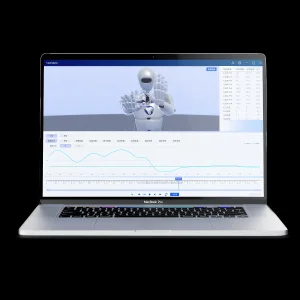
Bridging human kinematics to multi-actuated humanoid robotics is the vanguard of autonomous systems. Leveraging the DreamsCap X1 and VDRobot Studio, human demonstrators stream full-body joint configurations and dexterous micro-gestures (mHand Pro) directly to robotic controllers over UDP/WebSocket with negligible latency.
The framework supports direct data conversion into ready-to-use robot motion datasets, training vision-language-action (VLA) foundation models and sim-to-real reinforcement agents with biologically optimized movement vectors.
The Next Decade of Biomechanical Innovation
Emerging technological convergences that are shaping next-generation sensor fusion, real-time spatial computing, and wearable intelligent interfaces.
Hybrid Optical-Inertial Fusion
The boundaries between optical tracking and inertial sensing are dissolving into unified multimodal architectures. By synchronizing low-profile inertial suits with lightweight markerless optical cameras (such as YanDong optical technology), systems achieve the absolute global millimeter anchor accuracy of optical systems coupled with the high-frequency occlusion immunity of inertial IMUs.
Edge-Native Neural Kinematics
Future sensor suites will bypass external host computation by embedding tiny neural network inference engines directly into hub microcontrollers. These neural kinematic solvers continuously estimate soft-tissue artifact (STA) shifts, muscle deformation errors, and joint axis non-linearities directly at the limb boundary, outputting refined skeletal positions with minimal host bandwidth.
Direct-to-Cloud Distributed Telemetry
5G RedCap and ultra-wideband (UWB) integrations are facilitating direct edge-to-cloud kinematic telemetry. Distributed multi-subject trials—such as military infantry drills across outdoor zones or multi-site clinical orthopedic studies—can stream synchronized spatial coordinate frames into unified cloud dashboards without localized receiver hardware.
Enterprise Procurement Matrix: Evaluating Biomechanical Suppliers
Key performance benchmarks and technical verification criteria for CTOs, principal investigators, and engineering procurement committees.
Technical Due Diligence Checklist
Prior to executing procurement contracts for high-throughput motion capture systems, engineering committees must assess these functional benchmarks:
- Dynamic Magnetic Immunity: Does the firmware demonstrate fast recovery after exposure to 500+ Gauss iron beams or electric motors?
- Software Licensing Overhead: Does the vendor charge recurring seat fees or offer perpetual nodes with free API streaming?
- Synchronization Interfaces: Native support for Genlock, SMPTE timecode, ROS / ROS2 topics, and UDP/TCP broadcast formats.
- Wearable Ergonomics & Hygiene: Breathable, washable textiles with detachable sensors for institutional sanitization.
Virdyn Enterprise Service Level Agreement (SLA)
Institutional deployment requires uncompromising reliability. Virdyn delivers an enterprise procurement ecosystem customized for international academic, industrial, and defense buyers:
- Comprehensive Warranty & Fast Spares: Replacement sensor nodes and hardware components dispatched globally via express courier.
- Direct SDK & Source Integration: C++, Python, and C# SDK access with pre-built wrappers for Unreal, Unity, ROS, and MATLAB.
- Dedicated Remote Onboarding: Live engineer-led calibration, kinematic rig retargeting, and pipeline integration sessions.
- Academic & Volume Tiered Pricing: Structured capex discount models for university laboratories and research consortia.
Frequently Asked Questions: Kinematics & Systems Integration
Detailed technical answers to common queries regarding IMU accuracy, anti-interference measures, engine plugins, and robotics interfaces.
How does the Virdyn Biomechanical Suit mitigate magnetic field interference in reinforced concrete environments?
What angular joint resolution and temporal latency does the VDSuit Full achieve?
Can kinematic coordinate frames be mapped directly into ROS / ROS2 humanoid robot controllers?
What export formats are supported for clinical gait analysis and DCC animation software?
How does Virdyn's total cost of ownership compare with traditional optical capture studios?
Specialized Hardware, Teleoperation & Production Toolsets
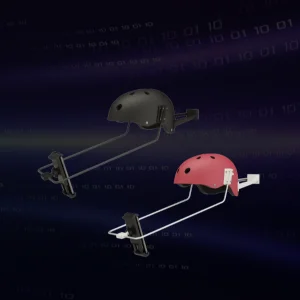
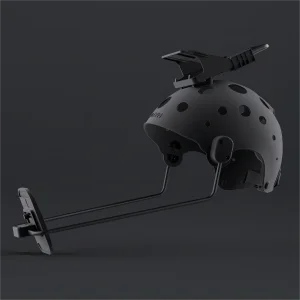
Complete your deployment architecture with reinforcement learning toolkits, specialized facial capture helmets, and studio-grade retargeting systems.




Biomechanical Suit System Planning Blueprint
Developing a modern human biomechanics data collection or embodied humanoid teleoperation platform demands complete architectural harmony across MEMS sensing nodes, deterministic wireless transmission, drift-compensating filtering, and skeletal solver algorithms. Guangzhou Virdyn Network Technology Co., Ltd. continues to advance full-stack movement capture architectures from the ground up, combining high-yield production infrastructure in Southern China with open, non-proprietary software integration workflows.
Whether establishing an institutional clinical gait analysis laboratory with our Valyze software, driving dexterous robotic hands through mHand Pro, or conducting large-scale ergonomic assessments, our specialized technical planning team delivers tailor-made hardware-software architectures matching your exacting data integrity specifications.