Design Virdyn VDSuit Full for Berlin Full Body Mocap Stages
Explore VDSuit Full
End-to-end performance tracking architecture engineered for immediate integration into Berlin studio stages, virtual live labs, and game development hubs.

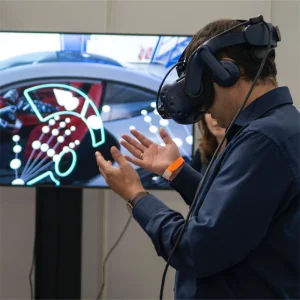

A strategic overview of optical tracking deployment across Studio Babelsberg virtual stages, Adlershof scientific research facilities, and the metropolitan digital startup corridor.
The historic film epicenter surrounding Potsdam-Babelsberg and Berlin Media City requires low-latency spatial calibration for real-time in-camera visual effects (ICVFX). Optical tracking provides sub-millimeter volume capture necessary for LED wall parallax precision and dynamic camera tracking.
At Germany's premier science park in Adlershof, advanced robotics engineering, biomechanical validation, and computer vision teams demand uncompromised 6-DoF telemetry. High-frame-rate multi-camera optical setups supply accurate ground-truth datasets for embodied AI agents.
Berlin's vibrant indie game scene—bolstered by Games Ground Berlin and local federal incubation initiatives—seeks hybrid tracking workflows that blend marker-based optical camera arrays with wearable sensor gloves for rapid asset retargeting and minimal manual clean-up.
Enterprise buyers prioritize unified data pipelines, rapid recalibration cycles, and flexible multi-actor capacities over isolated hardware specifications.
Modern procurement directors evaluate volumetric installations based on dynamic capture volumes (up to 20m x 20m), sub-millimeter marker reconstruction, active versus passive retro-reflective tagging, and robust handling of optical occlusion during complex multi-actor stunt sequences.
To mitigate high setup friction in confined studio layouts across Kreuzberg or Mitte, enterprises are choosing unified architectures: optical arrays track global camera and root positioning, while inertial sensor suits and dexterous gloves handle high-speed articulated joint rotations.
Cross-disciplinary technical blueprints adapted to European operational standards, broadcast requirements, and academic facilities.
| Vertical Segment | Core Technical Bottleneck | Optical / Hybrid Planning Solution | Deliverable / Operational ROI |
|---|---|---|---|
| Virtual Production & Film | Lens latency, stage reflection & marker clutter on LED volumes | Active IR LED tracking clusters integrated with dedicated lens encoders and live Genlock sync | Zero visible marker footprint; frame-accurate camera parallax in Unreal Engine |
| AAA Gaming & Animation | Long post-processing clean-up times for finger contact & prop interaction | Optical rigid body marker rigs coupled with multi-node IMU gloves (mHand Pro) | 80% reduction in post-cleanup animators' hours; real-time preview |
| Humanoid Robotics & Embodied AI | Lack of high-fidelity ground truth positional data for dexterous tasks | Dual-layer optical marker tracking paired with first-person egocentric spatial vision | Millimeter-level joint displacement datasets for training reinforcement learning agents |
| Ergonomics & Sports Biomechanics | Restricted operational spaces inside testing laboratories and cleanrooms | Compact wide-angle optical cameras configured with automated self-calibration wands | Standardized ISO kinematic reporting; instant biomechanical angular extraction |
Hardware, RF wireless management, and telemetry architectures strictly adhere to European Union health, radio, and enterprise data requirements.
All RF transmitters and active optical strobes operate strictly within EU harmonized spectrum bands (2.4GHz / 5.8GHz / Sub-GHz ISM bands), fully complying with the European Radio Equipment Directive (RED 2014/53/EU) to guarantee interference-free operation alongside professional wireless audio equipment.
Volumetric point-cloud telemetry and skeletal joint vectors are treated with utmost privacy. Our recording pipelines store kinematic spatial coordinate files without requiring identifiable biometric identity metadata, meeting rigorous EU GDPR (DSGVO) standards for institutional research.
We provide bespoke optical ceiling truss layout planning, optical bounce minimization analysis, custom camera lens angle calculations, and turnkey network synchronization architecture for facilities throughout Berlin, Brandenburg, and wider DACH regions.
How spatial capture is evolving from passive marker arrays into edge-accelerated, neural markerless volumetric pipelines.
Zero-latency continuous auto-re-calibration between high-frame-rate optical root anchors and wearable IMU body arrays to eliminate marker dropouts.
Deployment of camera-integrated edge AI processing to reconstruct complex human multi-body skeletons simultaneously without retro-reflective markers.
High-resolution multi-view telecentric optics enabling microscopic tracking of fingertip micro-tremors and subtle facial muscular expressions simultaneously.
Fully self-calibrating volumetric capture stages that dynamically reconfigure lens fields of view and lighting compensation in response to performer density.
Answers to technical, operational, and integration inquiries asked by studio managers and university researchers.
Planning a new stage in Berlin or upgrading an existing motion capture volume? Submit your stage dimensions, required actor capacity, and engine pipeline to receive a tailored architectural proposal within 24 business hours.
Send Inquiry NowSelect from specialized inertial suits, studio-grade data gloves, synchronized software engines, and industry-tailored pipeline packages.