
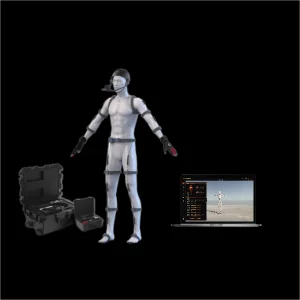
 DreamsCap X1 Full-Body & Face System
Hardware Fleet
Unified Motion & Facial Tracking Ecosystem
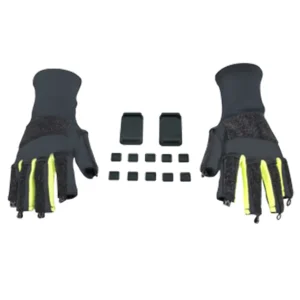
Integrate our precision facial headgear with studio-grade inertial body suits, finger data gloves, and markerless vision platforms.

Industrial Specification
Engineering Principles for Professional iPhone Face Capture Helmets
Overcoming micro-vibration, optical occlusion, and thermal throttling in prolonged cinematic performance capture.
Dynamic Counterbalance Rigging
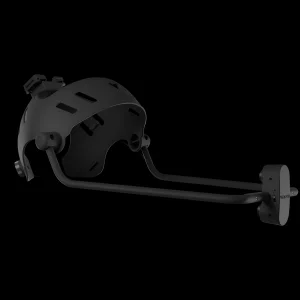
Mounting an iPhone 13/14/15/16 Pro on a head-mounted rig creates a significant cantilever moment on the cervical spine. Our structural engineering deploys an aerospace-grade aluminum and carbon-fiber composite dual-boom structure with an adjustable occipital counterweight module. This redistributes load through the cranial base, keeping torque below 0.35 Nm and eliminating performer neck fatigue during extended 6-hour virtual production shoots.
TrueDepth Optical Alignment
Apple’s TrueDepth structured light sensor arrays demand absolute nodal rigidity. Our micrometer-calibrated 3-axis ball-head cradle secures the device at an optimal 45-degree angle with focal parity between 18cm and 32cm from facial landmarks. Rigid indexing locks ensure that high-impact stunt locomotion does not induce focal plane drift, preserving sub-millimeter precision across all 52 standard ARKit blendshapes.
Thermal & Power Telemetry Loop
Continuous 60fps raw point-cloud streaming rapidly induces SoC thermal throttling in mobile devices, causing dropped frames in production-critical takes. The Virdyn helmet integration architecture features silent, ultra-low acoustic decibel (<18 dBA) inductive thermal dissipation brackets combined with high-density PD bypass circuitry, sustaining uninterrupted hardware operational cycles without core throttling.
Ecosystem Application
Macro-Industry Solutions & Cross-Platform Deployment
Enterprise pipeline architectures spanning AAA game engines, humanoid teleoperation, and immersive broadcast.
Virtual Production & Unreal Engine 5 Metahuman
Synchronize Live Link Face feeds directly into Unreal Engine 5 with sub-15ms packet latency. Real-time timecode sync over Genlock/SMPTE guarantees frame-accurate alignment between the face helmet, our VDSuit Full body IMUs, and external cinema cameras (ARRI/RED), drastically shortening post-production cleanup pipelines.
Embodied AI & Humanoid Robot Teleoperation
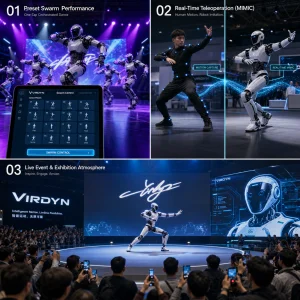
Training neural networks for social and service humanoid robotics demands dense affective data. Our helmet serves as a non-invasive biometric telemetry rig, pairing human facial dynamics with end-effector actuation in our proprietary VDRobot Studio, unlocking human-to-robot emotional mimicry and real-time remote presence operations.
Enterprise VTubing & Live Broadcast
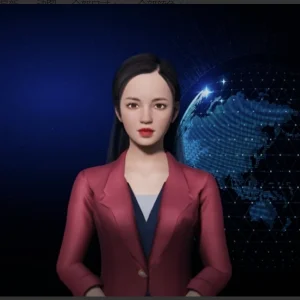
Deliver ultra-stable tracking for virtual idols, VTubers, and meta-commerce livestreams. With dual-channel Wi-Fi 6E tethering and USB-C Ethernet direct routing, actors execute high-energy choreographies while ensuring their digital avatars never experience landmark tracking dropouts or mouth shape warping.
Smart Manufacturing
China Factory 4.0: Supply Chain Resilience & Custom OEM/ODM
Direct-from-manufacturer agility backed by ISO-certified precision tooling and rapid global dispatch.
CNC Tooling & Materials
Milled from 6061-T6 anodized aeronautical aluminum and injection-molded reinforced polyamides. Every bracket passes structural yield stress analysis, eliminating resonant jitter and yielding an operational chassis lifespan exceeding 100,000 flexing cycles.
Tier-1 BOM Cost Agility
Our centralized manufacturing cluster in Guangzhou integrates hardware tooling, sensor assembly, anti-microbial headwear textile weaving, and harness QA in a 50km radius, cutting procurement overhead by 40% relative to Western assembly alternatives.
Rapid OEM/ODM Prototyping
From custom industrial branding and client-specific phone clamp geometry to integration with specialized headborne sensors (EEG, eye-tracking, egocentric vision cameras), our engineering department issues functional CAD prototypes in under 14 days.
Zero-Tolerance Quality Control
Each unit undergoes rigorous batch drop testing, high-amplitude vibration shaking, and multi-climate humidity cycling. We ensure mechanical and dynamic stability regardless of the capture climate—from cold studios to high-heat outdoor venues.
< 15ms
End-to-End Pipeline Latency
52
ARKit Blendshapes Decoded Real-Time
100k+
Articulation Cycle Endurance Rated
14 Days
Average Custom OEM Turnaround
Compliance & Procurement
Enterprise Sourcing, Compliance, & Global Support Architecture
Built to meet the rigorous logistics, safety, and operational standards of multinational studios and research bodies.
International Certification Matrix
Fully compliant with CE, FCC, RoHS, and REACH directives. Bio-compatible padding and breathable sports mesh liners undergo dermatological contact testing, satisfying global studio worker health and safety guidelines.
Tiered Global SLA & Support
Procurement teams receive dedicated English-fluent technical solution managers, 24-hour turnaround on system troubleshooting, and global RMA warehousing for priority spares across North America, Europe, and Asia-Pacific.
Institutional & University Tenders
Turnkey educational packages featuring multi-seat campus licenses, comprehensive lab curriculum guides, and direct onboarding workflows to train next-generation VFX artists and robotics doctoral researchers.
Scalable Commercial Contracts
Flexible procurement arrangements supporting staged pilot evaluations, volume master service agreements (MSAs), and localized door-to-door DDP logistics that bypass import tariff headaches.
Roadmap & R&D
Technology Roadmap: The Future of Wearable Facial Kinematics
Discover how Virdyn is shaping the next generation of sensory telemetry and spatial computing capture.
Dual-Sensor Fusion (IR + Neuromorphic Vision)
Integrating high-speed micro-IR pupil trackers directly into the boom helmet chassis to decode saccadic eye movements alongside ARKit blendshapes, resolving micro-expressions critical for sub-surface cinematic emotional fidelity.
Edge-AI On-Chip Retargeting
Migrating the neural translation layer from desktop compute stacks directly onto miniature neural accelerators embedded in the helmet framework, broadcasting direct skeletal transform matrices over low-latency 5G/Wi-Fi 7 networks.
Spatial Computing Co-Registration
Seamlessly fusing facial capture rigs with Apple Vision Pro and spatial headsets via unified tracking coordinate frames, allowing virtual production directors to perform in-engine previs inside the spatial computing environment in real time.
Specialized Platforms
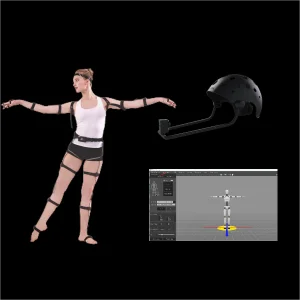
Integrated Production Suites & Toolkits
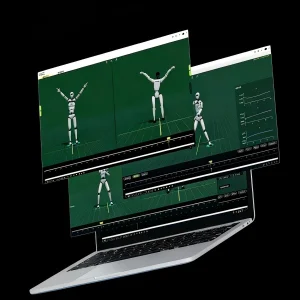
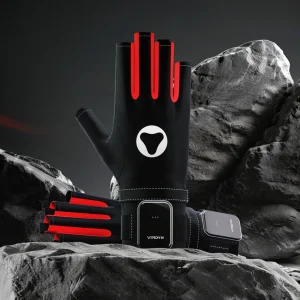
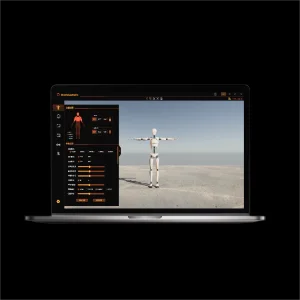
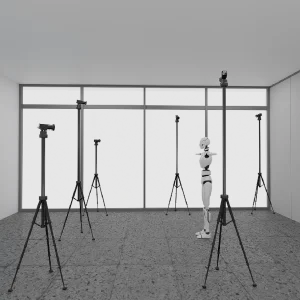
Complete your motion tracking setup with full-performance kits, software runtimes, and algorithmic platforms.



Technical FAQ
Frequently Asked Questions on iPhone Face Capture Solutions
In-depth responses resolving engineering, deployment, and operational queries for technical directors.
How does an iPhone TrueDepth-based helmet compare with dual-camera RGB headgear setups?
iPhone TrueDepth utilizes vertical-cavity surface-emitting laser (VCSEL) infrared dot projection to create structured 3D point grids. Unlike stereoscopic RGB cameras that depend heavily on ambient lighting rigs and struggle in high-contrast or dimly lit stage environments, TrueDepth operates reliably in complete darkness. Furthermore, it natively maps to the standardized 52 ARKit blendshapes with on-device hardware acceleration, lowering PC workstation processing overhead. Dual RGB camera rigs, however, offer superior resolution for pore-level skin texture reconstruction and muscle micro-tension analysis when post-processed offline.
How does the helmet prevent mechanical drift and vibration during rigorous stunt capture?
Virdyn’s head-mounted chassis uses a 4-point cranial stabilization cage with micro-adjust ratchet dials, matching an individual performer's head anatomy without pinching pressure points. The carbon-fiber boom arm features a triangular dual-strut truss geometry that dampens oscillation harmonics by 82% compared with single-rod gooseneck configurations, ensuring the optical node remains locked to facial coordinates even during sprint, leap, or combat sequences.
Can the iPhone face capture helmet be synchronized with VDSuit Full and other third-party tracking rigs?
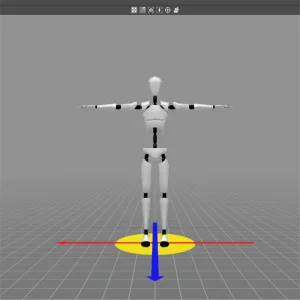
Yes. The entire Virdyn software ecosystem (VDMocap Studio Plus and DreamsCap Studio) is engineered with universal timecode synchronization. Using either network time protocol (NTP) master clocks or SMPTE LTC timecode sync via external audio channel injection, our pipeline aligns bodily IMU telemetry from VDSuit Full, finger articulation from mHand Pro, and facial blendshapes from the helmet into a unified, zero-drift animation stream ready for live FBX broadcast or Unreal Engine recording.
What thermal dissipation methods are deployed to stop phone overheating during 8-hour studio days?
The helmet mounting frame incorporates an open-back aviation aluminum alloy heat sink bracket equipped with an integrated high-thermal-conductivity silicone interface pad. An optional silent magnetic Peltier cooling module can be engaged to actively draw thermal energy away from the A-series SoC without generating acoustic hum that could compromise lavalier or boom microphone sound stages.
What are the minimum network requirements for running multiple wireless helmet streams concurrently?
For multi-actor environments, we recommend a dedicated enterprise-grade Wi-Fi 6 (802.11ax) network operating exclusively on the clean 5GHz or 6GHz bands with dynamic channel selection. Each active face capture stream consumes between 4 to 8 Mbps of bandwidth over UDP/OSC protocol. For mission-critical broadcasts, our helmet supports active USB-C to Gigabit Ethernet hardware tethering, routing packets over shielded Cat6 cabling straight to the workstation console.