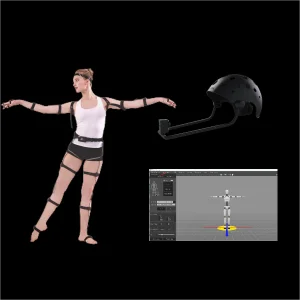
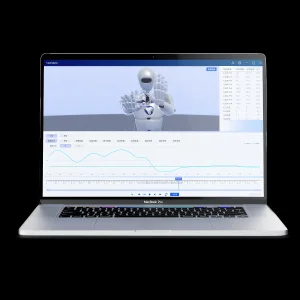
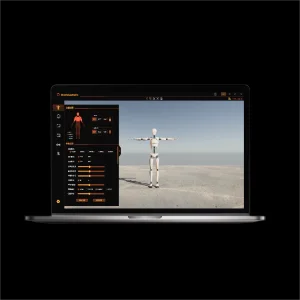
Enterprise Hardware & Integrated Software Solutions
Explore production-ready motion capture suites, optical markerless systems, multi-node inertial gloves, and robotics teleoperation architectures designed for scalable industry pipelines.


The Evolution of Markerless Motion Capture: From Laboratory CV to Real-Time Spatial AI
Optical markerless tracking has bypassed classical retro-reflective constraints through deep neural networks, transformer-based volumetric pose estimators, and multi-view vision solvers, radically reshaping enterprise spatial computing.
Multi-View Computer Vision & NeRF
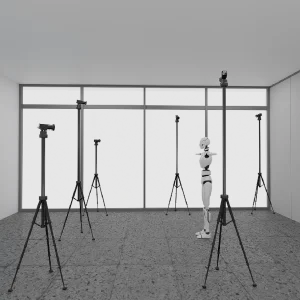
Traditional motion tracking required specialized body suits lined with passive retro-reflective markers or active LEDs, needing intensive manual recalibration and cleanup. Modern computer vision utilizes synchronized high-speed video arrays coupled with multi-camera neural spatial fields to calculate continuous skeletal joint centers with sub-centimeter volumetric precision.
- Zero wearable requirement ensures natural athletic performance.
- Eliminates marker detachment risks during intense physical contact.
Deep Learning Biomechanical Solvers
By ingesting millions of annotated frames, 3D spatial transformers and physics-informed neural networks (PINNs) eliminate unfeasible bone twisting, inverse kinematic discontinuities, and phantom joint pops. The solver respects true human physiological constraints, preserving center-of-mass momentum and skeletal kinematic chains effortlessly.
- Real-time inverse kinematics integrated directly inside edge nodes.
- Continuous bone length enforcement prevents foot-sliding artifacts.
Multi-Modal Hybrid Fusion (Optical + IMU)
While markerless tracking resolves global spatial coordinates without environmental drift, optical line-of-sight occlusion remains an inherent physical challenge in complex multi-actor or prop-heavy environments. The gold standard in high-tier spatial computing fuses markerless optical coverage with inertial telemetry (IMU) for uninterrupted fidelity.
- IMUs retain rotational orientation during total visual occlusion.
- Cameras perpetually calibrate and zero-out inertial gyroscopic drift.
Global Enterprise Procurement: Sourcing Modern Motion Capture Infrastructures
Evaluating enterprise-grade motion tracking systems requires dissecting total cost of ownership (TCO), operational agility, deployment ergonomics, and cross-engine pipeline viability.
Total Cost of Ownership (TCO)
Legacy optical systems incur massive recurring overhead: marker consumables, adhesive replacements, dedicated suit laundries, and weeks of labor-intensive post-capture manual curve cleanup. Markerless infrastructure drastically amortizes TCO by turning any controlled space into a production volume with instant turnaround.
Rapid Subject Calibration
Traditional marker tracking requires 30 to 45 minutes per actor for suit fitting, tight marker measurement, T-pose calibration, and Range-of-Motion (ROM) passes. Markerless vision engines achieve instantaneous zero-touch subject identification in milliseconds, allowing rapid turnaround across dynamic cast rosters.
Volume Portability & Setup
Rigid gantry truss structures with heavy fixed cabling limit enterprise nimbleness. Contemporary planning strategies favor distributed gigabit Ethernet (GigE Vision) or ultra-fast USB3 camera pods mounted on quick-release field tripods, transforming rehearsal stages, boardrooms, and medical wards into active capture zones.
DCC & Game Engine Telemetry
Data isolation kills production velocity. Enterprise buyers mandate native SDK integrations and live broadcast plugins for Unreal Engine (Live Link), Unity, Autodesk Maya, Blender, and MotionBuilder, streaming bone transforms and root motion with zero dropped frames over standard VRPN or OSC protocols.
Macro Industry Solutions: Cross-Sector Kinetic Deployments
Discover how unencumbered markerless kinematics and hybrid sensor tracking deliver exponential productivity leaps across entertainment, robotics, medical biomechanics, and virtual human live streaming.
Virtual Production & Film VFX
On LED volume virtual production stages, retro-reflective tracking markers create severe optical reflections and disrupt camera view frustums. Markerless vision arrays track directors, actors, and camera operators unobtrusively, driving real-time digital doubles, photorealistic set interaction, and in-camera VFX (ICVFX) without visual pollution.
Embodied AI & Humanoid Robotics
Humanoid robotic autonomy relies upon vast corpora of high-fidelity human demonstration data. Markerless optical systems and egocentric cameras capture natural tool manipulation, walking gaits, and spatial navigation without encumbering human demonstrators, streaming clean joint trajectories straight into imitation learning models and teleoperation rigs.
Clinical Gait & Sports Ergonomics
Marker placement in clinical settings introduces human error, palpation variability, and patient discomfort. Markerless kinetic solutions analyze pathological gaits, orthopedic recovery, and elite athletic performance in pristine natural environments, generating objective joint angles, velocity profiles, and kinetic load metrics instantaneously.
Engineering Trade-Off Matrix: Optical Markerless vs. Optical Marker vs. Inertial IMU
A rigorous architectural breakdown highlighting spatial accuracy, deployment overhead, occlusion resistance, and operational parameters across current motion capture standards.
| Evaluation Parameter | AI Optical Markerless (YanDong) | Passive Optical Markers | Inertial Suit (VDSuit Full) | Hybrid Fusion (Optical + IMU) |
|---|---|---|---|---|
| Performer Setup Time | Instant (Zero Wearables) | 35 - 50 mins (Suit & Markers) | 5 - 10 mins (Wearable Suit) | 8 - 12 mins (Targeted Nodes) |
| Capture Volume Restrictions | Flexible Multi-Camera Array | Fixed High-Rig Calibration | Completely Unlimited | Expanded Bounded Volume |
| Occlusion Sensitivity | AI Inferencing & Multi-View | High (Requires Manual Patch) | Zero Occlusion Impact | Self-Correcting Robustness |
| Global Position Precision | Sub-centimeter Accurate | Sub-millimeter Benchmark | Relative (Prone to Drift) | Absolute Grounded Truth |
| Environmental Light Tolerance | Controlled Natural/Studio Light | Strict Infrared Tuning | Immune to Ambient Light | High Ambient Tolerance |
| Post-Capture Cleanup Labor | Minimal / Real-Time Clean | Extensive Manual Rigid Solver | Instantaneous Clean Curve | Near-Zero Manual Cleaning |
| Capital Investment Ratio | Moderate (Standard HW) | Extremely High ($80k - $250k+) | Cost-Effective Entry | Optimized Mid-Tier TCO |
Enterprise Security, Biometric Compliance & Global Support Architecture
Industrial clients deploying vision tracking across sovereign facilities require strict regulatory compliance, data protection, and localized enterprise engineering support.
GDPR & Biometric Privacy Standards
Optical video streams contain identifiable biometric records. Enterprise markerless engines provide on-premise local compute isolation where raw RGB feeds are processed in volatile RAM and immediately converted to anonymous skeletal coordinate vectors, guaranteeing strict compliance with GDPR, CCPA, and ISO/IEC 27001 mandates.
On-Premise Air-Gapped Deployments
Defense labs, automotive design studios, and top-tier VFX houses operate under strict NDA and air-gapped network security. Our markerless processing nodes function 100% offline without telemetry pingbacks, software-as-a-service cloud dependencies, or external credential handshakes, ensuring total data sovereignty.
Worldwide SLA & Field Engineering
From initial volume blueprint design and lens focal length selection to custom C++ SDK development and onsite calibration, institutional buyers receive dedicated Tier-3 engineering assistance, guaranteed 24-hour turnaround service-level agreements (SLA), and lifecycle firmware updates.
Engineering Roadmap: The Frontier of Neural Motion Reconstruction
A strategic overview of upcoming technological breakthroughs revolutionizing non-invasive kinetic tracking across edge computation and generative spatial foundations.
3D Gaussian Splatting Integration
Real-time reconstruction of volumetric dynamic subjects directly from unsynchronized video feeds, merging dense surface deformation tracking with skeletal rigging in one seamless pipeline.
Edge NPU Embedded Solvers
Migrating multi-camera transformer inferences straight onto smart camera edge tensor processing units (NPUs), eliminating server rack clusters and streaming lightweight bone rig coordinates directly over Wi-Fi 7.
Physics-Informed Contact Estimation
Deep neural prediction of ground reaction forces (GRF) and tactile interaction friction purely through video analysis, enabling photorealistic muscle bulge, cloth tension, and biomechanical joint torque estimation.
Generative Foundation Motion Models
Zero-shot text-and-vision motion foundation models capable of hallucinating highly occluded kinematic details, auto-completing complex multi-actor acrobatic contact maneuvers with absolute spatial realism.
Markerless Motion Capture FAQ: Technical Architecture & Procurement
Detailed engineering answers to critical architectural and integration questions frequently raised by studio supervisors, research directors, and enterprise buyers.
How does markerless motion capture achieve skeletal precision without physical markers?
What are the minimum hardware specifications and camera setup required for a commercial volume?
Can markerless capture handle rapid athletic movements and complex multi-actor occlusions?
How is data streamed directly into game engines like Unreal Engine and Unity?
What is the typical recalibration frequency required for markerless camera rigs?
Specialized Kinetic Accessories, Egocentric Vision & Analysis Software
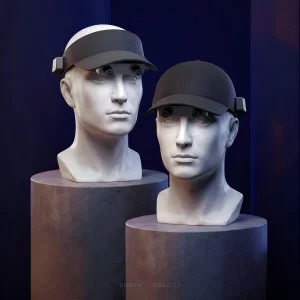
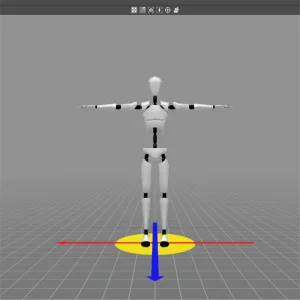
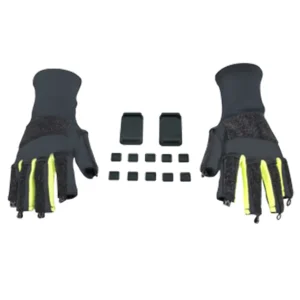
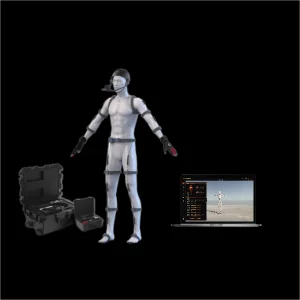
Complete your production ecosystem with professional motion analysis tools, egocentric video collectors, humanoid robotics teleoperation kits, and custom avatar assets.