

Featured Hardware & Toolkits

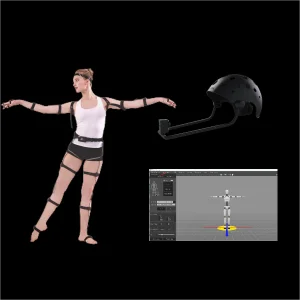
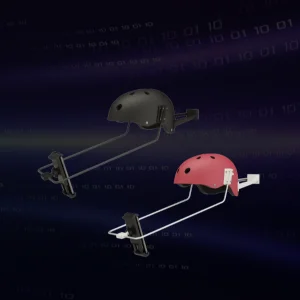
Flagship Motion Capture Infrastructure for Web3 Deployment
Explore production-grade inertial suits, optical tracking peripherals, and full-performance real-time capture rigs engineered to bridge physical human motion into verifiable on-chain virtual assets and metaverse spaces.
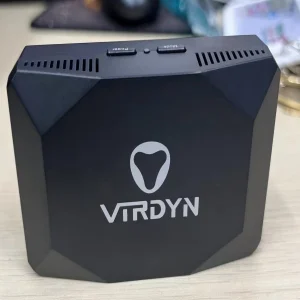
Design Full Body Motion Capture Accessories for Suit Hub Planning, Solution
Explore Solution
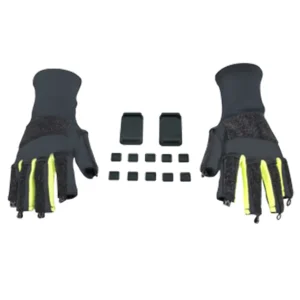
Best Inertia Motion Capture Fingers Capture Accessories Elastic Lycra Fabric Gloves for VDSuit Full(Without Sensors) Planning, Solution
Explore Solution
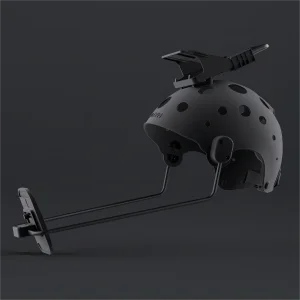
Best Virdyn VDFace Pro Capture System for Real Time Facial Capture with Face Capture Helmet Planning, Solution
Explore Solution
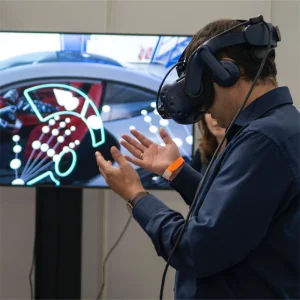
Design Book a Demo for VDSuit Full or mHand Pro Planning, Solution
Book Live Demo
Best How Do Brands Use Virtual Spokesman to Tell Good Stories: Motion Capture Technology Empowers Brand Propagation Planning, Solution
Explore Solution
Design VDCap Full Performance Capture Entry-Level Motion Capture Kits for Beginners and Hobbyist Planning, Solution
Explore Solution
Best Virdyn VDFace Capture System for Real Time Facial Capture with Face Capture Helmet Planning, Solution
Explore Solution
Executive Industry Synthesis
The Paradigm Shift: From Offline Keyframing to Cryptographic Live Kinematics
Web3 architecture fundamentally alters human-computer interaction by transitioning digital representations from static, siloed 3D avatars into decentralized, interoperable, and persistent digital identities. At the core of this transition lies a profound engineering challenge: how to capture, translate, serialize, and verify high-fidelity physical human motion into decentralized digital environments in real time without prohibitive computational and spatial overhead.
<15ms
End-to-Edge Data Fusion Latency
99.8%
Magnetic Interference Rejection
100%
EVM / Solana On-Chain Retargeting Ready
Zero
Camera Occlusion via IMU Node Array
Sovereign Biometric Provenance
Traditional motion capture treats animation data as transient post-production files (e.g., FBX, BVH). In the Web3 economic stack, movement parameters constitute sovereign biometric intellectual property. By combining low-latency hardware with cryptographic hashing, performers can sign their movement data streams with decentralized identities (DIDs), creating provably authentic virtual performances and immutable gesture-based digital assets.
DePIN & Edge Pipeline Integration
Centralized optical capture stages require tens of calibrated optical tracking cameras, dedicated optical technicians, and fixed studio footprints exceeding millions of dollars in capex. Web3 requires agile, wearable inertial measurement unit (IMU) architectures that operate seamlessly within decentralized physical infrastructure networks (DePIN), allowing performers to stream full-body skeleton coordinates directly over WebRTC and WebSocket backbones.
Autonomous Virtual Human Actuation
Web3 virtual idols, decentralized brand ambassadors, and DAO community hosts operate beyond static pre-rendered video loops. With inertial motion capture suits such as the VDSuit Full and high-resolution mHand Pro gloves, operators synchronize real-time physiological kinetics with AI natural-language processing models, delivering responsive, physically grounded interactions inside Unreal Engine 5, Unity, and custom WebGL metaverse viewports.
Enterprise Procurement Matrix
Global Corporate Procurement Criteria for Web3 Mocap Infrastructure
Corporate technology officers, decentralized entertainment production leads, and Web3 game developers evaluate motion capture solutions based on rigorous criteria that diverge significantly from traditional VFX motion capture studios.
| Evaluation Parameter | Virdyn Web3 Mocap Engineering Standard | Legacy Optical Studio Setup | Consumer Webcam / Computer Vision |
|---|---|---|---|
| Spatial Flexibility & Mobility | Infinite Volume Operates anywhere; no physical optical markers or camera boundary | Confined to fixed 8m x 8m rigid trusses; high spatial footprint | Single-camera field of view; performance collapses on body turn |
| Network Transmission Overhead | Ultra-Lightweight Serialized quaternion vector arrays (~12 KB/s per actor) | Gigabyte-scale point cloud processing requiring specialized local fiber nodes | Video frame transmission requires hefty 4K bandwidth encoding |
| Magnetic Drift Mitigation | Dynamic Sensor Fusion Adaptive filtering algorithm resists metal stages & RF noise | Immune to magnetism, but severely vulnerable to optical occlusion | Immune to magnetism, vulnerable to low-light and clothing texture |
| Full-Performance Integration | Body (VDSuit) + Hands (mHand Pro) + Facial Rig (VDFace) natively unified | Multi-vendor fragmentation; cumbersome synchronization | Coarse finger estimation; highly unreliable micro-expression tracking |
| Total Cost of Ownership (TCO) | Optimal Enterprise Capex Immediate multi-unit global rollout capability | Prohibitive Capex ($150,000–$500,000+ per capture stage) | Low capex, zero commercial production reliability |
Architectural Blueprints
Macro Industry Solutions: Bridging Web3, Virtual Beings & Embodied AI
How leading enterprises integrate motion capture hardware across gaming ecosystems, decentralized virtual entertainment, on-chain intellectual property, and real-time physical robotics data pipelines.
Decentralized Entertainment & Web3 VTubers
The creator economy is rapidly migrating to decentralized live streaming where performers control their avatar IP through smart contracts. Virdyn provides a full-performance capture harness combining the VDSuit Full, mHand Pro gloves, and VDFace helmet. Through open-standard OSC protocols, performers stream live skeletal transforms directly into VRChat, Warudo, or customized WebGL environments, driving engagement while retaining full custody over performance assets.
Interoperable Avatars & ERC-6551 Token Bound Accounts
Metaverse identity is evolving beyond static PFP assets. Through integration with ERC-6551 token bound accounts and dynamic NFTs, avatar skins can store historical movement catalogs, martial arts repertoires, and signature performance gestures directly linked to their on-chain identity. Virdyn’s software exports pristine FBX and BVH sequences paired with cryptographic metadata, establishing provenance for decentralized in-game emote trade and performance licensing.
Embodied AI & Robotics Teleoperation in Web3
The frontier of Web3 spatial computing converges with Embodied AI and decentralized data markets. Humanoid robotics companies utilize VDSuitMini and VDRobot Studio to collect high-density human manipulation data. Decentralized data protocols incentivize human demonstrators worldwide to record fine-motor physical tasks, turning human physical labor into decentralized, monetizable dataset tokens via decentralized storage networks.
Long-Term Horizon
Engineering Roadmap: The Next Era of Web3 Kinematic Infrastructure
Virdyn’s progressive development trajectory targets the elimination of physical motion drift, zero-knowledge biometric encryption, and direct-to-chain spatial transaction pipelines.
Phase I: Foundation
Zero-Latency Edge Hubs
Deployment of dual-band 2.4G/5.8G RF transceivers integrated directly with local WebRTC nodes, slashing packet drop rates in congested esports arenas and corporate exhibition halls below 0.01%.
Phase II: Privacy
zk-SNARK Biometric Proofs
Architecting Zero-Knowledge proofs for skeletal motion vectors. Performers authenticate identity and gesture commands without leaking underlying bone length, height, or physiological identifiers to untrusted node networks.
Phase III: Autonomy
DePIN Data Synthesizers
Direct smart contract reward distribution for real-world kinetic training data. Motion captures executed on VDSuit Full and mHand Pro are instantly hash-verified and streamed to decentralized AI training clusters.
Phase IV: Convergence
Neural-IMU Fusion
Embedding lightweight neuromorphic edge processing inside each IMU node, achieving self-calibrating skeletal trajectory synthesis that entirely mitigates long-session drift without manual T-pose resets.
Commercial & Regional Analysis
Global Commercial Landscape: Realities of Industrial Implementation
Across major geographic enterprise hubs, the commercial requirements for motion capture technology have evolved from academic novelty into continuous, mission-critical operational tools.
North America: Interactive Web3 Gaming & AAA Previs
North American game studios and decentralized world builders demand zero-pipeline-friction. Integration with Unreal Engine 5.4+ Live Link is paramount. Studios deploy Virdyn’s inertial pipelines to iterate rapid combat animations, procedural movement libraries, and live community town halls inside customized metaverse instances, reducing animation turnaround cycles by up to 70%.
Asia-Pacific: High-Density VTubing & Virtual E-Commerce
APAC represents the densest market for real-time virtual characters and VTuber agencies. In South Korea, Japan, and China, commercial live streamers run 8-hour continuous daily broadcasts. Equipment must offer featherweight ergonomic fabric, high heat dissipation, rapid multi-actor battery swap capabilities, and robust anti-jamming algorithms in dense urban electromagnetic settings.
EMEA: Industrial Digital Twins & Ergonomics Validation
European enterprise buyers prioritize ergonomic compliance, worker safety simulation, and automotive cockpit evaluation within Web3 digital twin factories. Virdyn’s software suite—combined with Valyze motion analytics—enables precision biomechanical joint-angle reporting, ISO-standard ergonomic scoring, and localized GDPR biometric privacy sandboxing.
Governance & Trust
Biometric Privacy, Regulatory Compliance & Global Enterprise Support
Navigating the intersection of human biometric telemetry and decentralized ledgers requires rigorous adherence to data sovereignty and international manufacturing certifications.
GDPR & CCPA Biometric Protection
Kinematic motion capture records skeletal ratios, gait characteristics, and micro-movements categorized as biometric identifiers under GDPR Article 9. Virdyn implements edge-based anonymization filters within VDMocap Studio, stripping identifying facial point clouds and physical stature variances prior to on-chain broadcasting or remote cloud streaming.
International Hardware Certification
All Virdyn inertial sensor hubs, RF receivers, and battery charging nodes carry full FCC, CE, TELEC, and SRRC wireless telecommunication compliance. Sensor casings are constructed from impact-resistant, skin-hypoallergenic materials rigorously tested for heat dissipation and electrostatic discharge (ESD) immunity in diverse stage environments.
Enterprise SLA & Global Replacement Hubs
Enterprise clients benefit from comprehensive deployment protection, including guaranteed 24-hour engineering response, direct developer-to-developer SDK consultation for Unreal/Unity pipelines, and regional hardware spare modules stationed across North America, Europe, and Asia for rapid turnaround.
Technical Clarifications
Frequently Asked Questions: Web3 Mocap Architecture
Detailed technical answers for CTOs, lead system architects, and executive producers integrating motion capture suits into decentralized ecosystems.
How does inertial motion capture solve magnetic distortion in modern Web3 exhibition booths and stage setups?
Traditional IMU systems suffer from magnetic field anomalies caused by reinforced concrete, audio amplifiers, and steel floor trusses. Virdyn solves this via our proprietary multi-sensor data fusion engine. By utilizing high-frequency 9-axis sensor arrays (accelerometer, gyroscope, and magnetometer) paired with human biomechanical skeletal constraints, the algorithm dynamically identifies local geomagnetic anomalies and suppresses magnetometer weight, relying on drift-compensated gyroscopic integration to maintain an aligned, non-drifting skeleton.
What protocols are used to pipe real-time motion data into decentralized WebGL or Unreal Engine Web3 viewports?
VDMocap Studio outputs skeletal bone transforms via zero-latency UDP/TCP, OSC (Open Sound Control), WebSocket, and native Unreal Engine Live Link protocols. For browser-based decentralized 3D metaverses (such as Three.js or Babylon.js viewports), our lightweight WebSocket gateway pushes compact binary JSON or Protocol Buffer arrays (containing 27-node quaternion rotations), consuming under 15 KB/s per avatar, allowing massive multi-user virtual concerts without network congestion.
Can the mHand Pro gloves be deployed for robotic teleoperation and decentralized AI training pipelines?
Yes. The mHand Pro multi-node data glove is engineered for dual application across avatar performance and robotic teleoperation. Providing high-density multi-joint finger capture, the hardware interfaces directly with our VDRobot Studio platform. Teleoperators manipulate dexterous robotic hands with sub-millimeter dexterity, while the kinematic trajectory coordinates are indexed into standardized robotic dataset formats (e.g., ROS/ROS2 bag files) ready for tokenized Web3 dataset monetization.
How does Virdyn support developer integration with custom Web3 avatar formats (e.g., VRM, glTF)?
Virdyn provides flexible retargeting profiles natively compatible with humanoids rigged to standard HumanIK, Mixamo, Unreal Mannequin, and VRM skeletal bone hierarchies. Through our Unreal Engine and Unity SDKs, developers map real-time bone transforms to on-chain avatars minted via decentralized platforms in a few clicks, ensuring that user-owned dynamic assets respond immediately to real-time actor motions.
Extended Ecosystem Portfolio
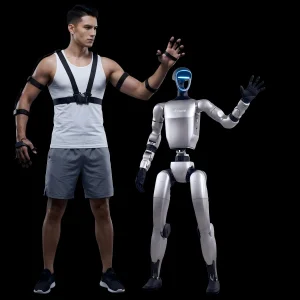
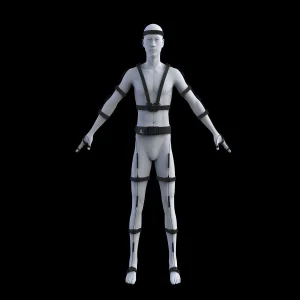


Specialized Capture Modules, Teleoperation & Optical Systems
Complete your deployment with half-body teleoperation suits, markerless optical motion tracking, robotic intelligence development platforms, and industry-grade capture accessories.
Best VDSuitMini Half-Body Mocap System | Robot Data Collection & Teleoperation | Free Software Planning, Solution
Explore Solution
Design Virdyn VDSuit Full for Full Body Function Inertia Motion Capture Suit Planning, Solution
Explore Solution
Best Virtual Live Technology Empowerment Makes Online Education and Learning As Fun As Watching Cartoons Planning, Solution
Explore Solution
Design VDRobot Studio: Motion Data Collection&Conversion Platform for Robotics | Virdyn Planning, Solution
Explore Solution
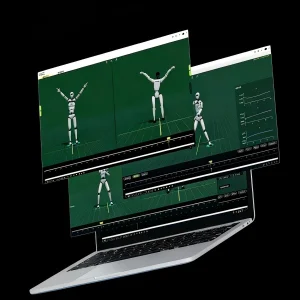
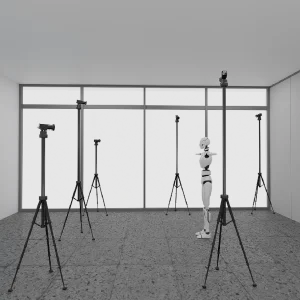
Best Camera Optical Markerless Motion Capture Solution - Virdyn YanDong | Real-Time Full Body, Hands, Face Planning, Solution
Explore Solution
Design Virtual Actors: How the Film Industry Should Layout the Virtual Market Planning, Solution
Explore Solution
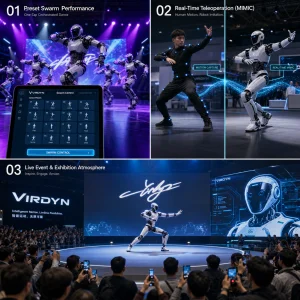
Best Virdyn Humanoid Robot Live Event Performance Solution for Robot ce&Teleoperation Planning, Solution
Explore Solution