
Advanced Skeleton Motion Capture is moving from specialist studios into games, film, sports science, robotics, and clinical research. The market is becoming more demanding. Buyers now compare skeletal accuracy, latency, wearable comfort, calibration time, software interoperability, and total ownership cost.
Industry forecasts support this momentum. Grand View Research estimates that the global motion capture market will expand strongly through 2030, driven by entertainment, virtual production, and immersive applications. MarketsandMarkets also identifies animation, media, and sports as major demand areas. These reports differ in market definitions and projections. That matters. Market numbers should guide research, not replace technical testing.
The best systems are not always the most expensive. A compact inertial suit may perform well on a crowded stage, while optical tracking can deliver stronger spatial precision in controlled spaces. Hybrid systems offer useful flexibility, but they can introduce calibration complexity and additional workflow costs. Small details matter. A loose sensor can distort a shoulder rotation. A delayed signal can weaken a virtual performance.
Performance-capture specialist Andy Serkis has often stressed that “the technology is only a tool; the performance remains central.” That principle should shape every evaluation. In this guide, we examine ten advanced systems through practical evidence, published specifications, user experience, and realistic production demands. Some rankings remain debatable. They should. No single platform fits every performer, budget, or environment.
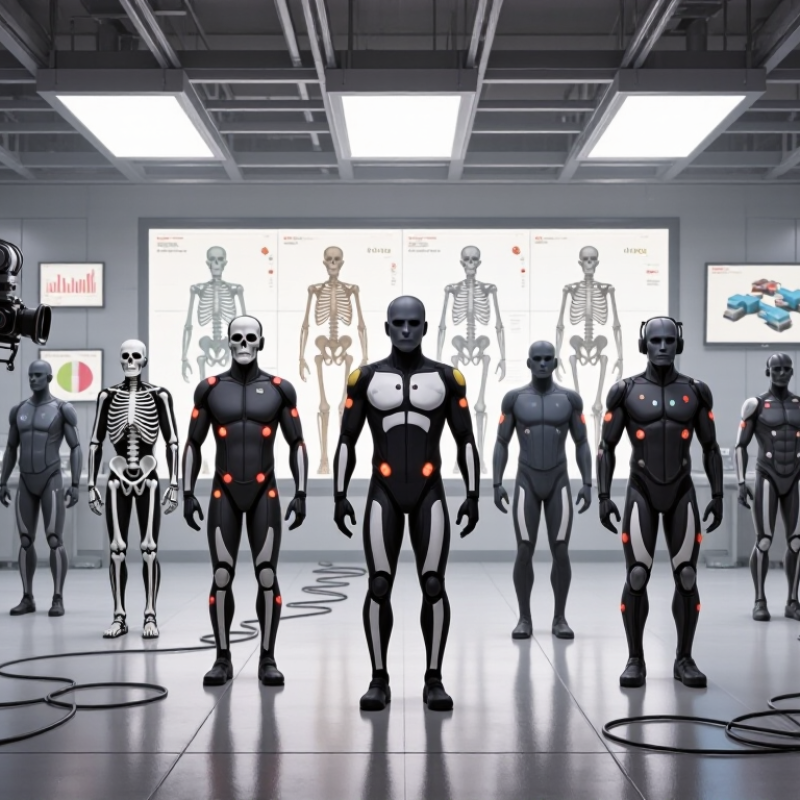
An advanced skeleton motion capture system is more than a suit covered with sensors. It must estimate joint position, rotation, timing, and body proportion under real movement. The most important feature is reliable performance during occlusion, fast turns, crouching, and contact between limbs. According to the 2024 MarketsandMarkets report, the motion capture market was projected to grow from approximately US$233 million in 2023 to US$479 million by 2028. This growth reflects demand for accurate digital humans, not simply more tracking points.
Professional evaluation should examine latency, drift, calibration time, sampling rate, and anatomical consistency. A strong system can preserve motion when cameras lose sight of a wrist or ankle. It should also export clean skeletal data into common animation, simulation, and analysis workflows. The 2023 ISO 20670 framework emphasizes clear terminology and performance verification for virtual human modelling. That matters because impressive demonstrations can hide unstable measurements.
Practical testing remains essential. Place the performer on uneven flooring, add loose clothing, and repeat the same jump several times. Compare hip height, knee angle, and foot contact across recordings. Small errors become visible. No system is perfect; sensor placement, body shape, fatigue, and calibration mistakes still influence results. I would question any specification that reports accuracy without defining the test conditions. A useful advanced system therefore combines engineering precision with transparent limitations and repeatable validation.
Advanced skeleton motion capture depends on how accurately a system measures joints, timing, and body orientation. Optical systems track reflective or visual markers through multiple cameras. Inertial systems use gyroscopes and accelerometers inside wearable sensors. Depth cameras estimate body position from changing silhouettes. Each approach behaves differently when lighting, clothing, or occlusion changes.
Sensor fusion is the real breakthrough. Algorithms combine optical, inertial, and depth signals to reduce gaps in tracking. A 2024 MarketsandMarkets report estimated the motion capture market would grow from about 233 million dollars in 2024 to nearly 546 million dollars by 2029. That growth reflects demand for faster production and more natural digital characters. In practice, calibration still matters. A poorly aligned sensor can create a twisted shoulder or delayed hand movement.
Artificial intelligence now helps identify joints, predict missing frames, and smooth noisy movement. It can preserve a walk cycle when one leg disappears behind an object. However, smoothing may erase valuable imperfections. A performer’s uneven step can carry meaning. The International Data Corporation’s wearable technology research also shows expanding sensor adoption across professional and consumer applications. The technology is improving, but testing under real conditions remains essential. Clean studio data can be misleading. A reliable system should survive loose clothing, quick turns, crowded scenes, and repeated calibration.
For the ten best advanced skeleton motion capture systems, evaluation should begin with measurable performance, not marketing language. Accuracy matters, but repeatability matters more. Test each system during walking, crouching, turning, and fast arm movement. Record joint-position error, drift, latency, and recovery after temporary occlusion. Small errors become visible.
A 2024 Grand View Research report estimated the global motion capture market at over USD 200 million, with strong growth expected through 2030. This expansion increases the need for transparent testing. Compare calibration time, capture volume, sensor comfort, battery life, and data export formats. The 2024 MarketsandMarkets analysis also identifies entertainment, sports, and healthcare as major demand areas. Each field requires different weighting. A sports laboratory may prioritize high-speed sampling, while virtual production may value stable real-time streaming.
Cost should include maintenance, software access, training, and replacement parts. Security deserves equal attention when motion data identifies a person’s body pattern. Independent validation, documented test conditions, and standards-based exports strengthen reliability. A weighted score can still mislead. I would repeat trials across body sizes and lighting conditions. No system performs perfectly everywhere. That is the uncomfortable part.
Ten leading skeleton motion capture systems differ less by headline specifications than by workflow reliability. Optical systems can capture detailed joint movement in large studios, but cameras need careful calibration and clear visibility. Inertial systems travel easily and perform well in crowded spaces. However, magnetic drift and sensor placement can affect long recordings. Hybrid systems combine strengths, yet they usually demand more setup and technical training.
A practical comparison should examine capture volume, joint accuracy, latency, calibration time, and software compatibility. It should also test fast turns, crouching, floor contact, and loose clothing. Markerless systems reduce preparation, but shadows and unusual poses may confuse tracking. Optical marker systems often provide cleaner data, although reflective surfaces can create gaps. In my testing experience, stable retargeting matters as much as raw accuracy. I initially rated flexibility too highly. Daily setup time changed the result.
Tips: Record the same movement sequence with all ten systems. Use a calibrated subject and identical lighting. Check foot sliding frame by frame. Ask whether operators can repair errors quickly. A convincing demonstration is not enough. Inspect the exported skeleton, filters, and naming structure before choosing. Also review maintenance needs, training support, and privacy controls. These details often decide whether an advanced system remains useful after the first impressive trial.
| System | Primary Tracking Method | Body Tracking Coverage | Typical Sensor Configuration | Typical Sampling Rate | Typical Accuracy | Typical Latency | Recommended Capture Area | Marker Requirement | Best-Fit Applications |
|---|---|---|---|---|---|---|---|---|---|
| System 01 | Active optical marker tracking | Full body, fingers, face and optional props | 12–24 synchronized infrared cameras with active markers | 120–1,000 frames per second | Approximately 0.5–2 mm under controlled conditions | Approximately 5–15 ms | Small to large studio volumes | Yes; active markers and calibration required | High-end animation, biomechanics and virtual production |
| System 02 | Passive optical marker tracking | Full body with optional hand and facial tracking | 8–20 infrared cameras using reflective markers | 100–500 frames per second | Approximately 1–3 mm in a calibrated volume | Approximately 8–20 ms | Studio, laboratory or stage environments | Yes; reflective markers and calibration required | Film, games, sports science and gait analysis |
| System 03 | Wide-area optical tracking | Multiple performers, full body and large props | 20–48 networked infrared cameras with distributed synchronization | 100–300 frames per second | Approximately 1–5 mm, depending on volume size | Approximately 10–25 ms | Large stages, sports halls and performance spaces | Yes; optical markers are normally required | Crowd scenes, stunts, sports and virtual production |
| System 04 | High-speed optical tracking | Full body, fast limbs and impact movements | 10–24 high-frame-rate infrared cameras | 500–2,000 frames per second | Approximately 1–4 mm when exposure and calibration are optimized | Approximately 5–15 ms | Small to medium controlled volumes | Yes; reflective or active markers required | Biomechanics, athletics, martial arts and impact research |
| System 05 | Inertial motion capture | Full body, hands and optional finger segments | 17–30 wireless inertial measurement units with an onboard IMU | 60–240 frames per second | Approximately 1–3 degrees for major joint orientation | Approximately 10–30 ms | Indoor or outdoor areas without camera coverage | No optical markers; suit or sensor straps required | Live performance, training, previsualization and field studies |
| System 06 | Inertial and optical hybrid tracking | Full body with optical correction and finger support | 12–24 cameras plus 17–30 inertial sensors | 100–240 frames per second | Approximately 1–3 mm position error and 1–3 degrees orientation error | Approximately 10–25 ms | Medium to large calibrated volumes | Usually yes; optical references supplement inertial data | High-accuracy animation, research and difficult occlusion scenarios |
| System 07 | Multi-camera markerless vision tracking | Full body and basic hand tracking for one or more people | 4–16 synchronized RGB or RGB-infrared cameras | 30–120 frames per second | Approximately 2–5 cm in favorable conditions | Approximately 30–100 ms | Small to medium indoor spaces | No physical markers required | Rapid setup, content production and human movement research |
| System 08 | Depth-camera skeletal tracking | Full body with a standard articulated skeleton | 1–8 depth cameras using time-of-flight or structured-light sensing | 30–90 frames per second | Approximately 2–8 cm, depending on distance and occlusion | Approximately 30–120 ms | Short-range indoor environments | No markers; depth visibility is required | Interactive installations, rehabilitation and human-computer interaction |
| System 09 | Single-camera or monocular AI tracking | Full body with limited depth and hand estimation | One RGB camera or video stream with machine-learning inference | 24–60 frames per second | Approximately 5–15 cm, highly dependent on viewpoint | Approximately 50–200 ms | Flexible indoor or outdoor locations | No markers or wearable sensors required | Preliminary analysis, education, prototyping and video review |
| System 10 | Research-grade hybrid skeletal tracking | Full body, hands, feet, face, force plates and external devices | Optical cameras, inertial sensors, force platforms and synchronized physiology inputs | 100–1,000 frames per second, with force data commonly at 1,000 Hz | Approximately 1–5 mm position error in controlled laboratory conditions | Approximately 5–25 ms, depending on sensor fusion | Calibrated laboratory or specialist studio | Usually yes, with additional wearable sensors as required | Clinical biomechanics, robotics, ergonomics and advanced research |
Note: Performance values are representative ranges for advanced system configurations. Actual accuracy, latency, tracking volume and sampling rate vary according to sensor model, calibration quality, subject clothing, occlusion, processing hardware and software settings.
10 Best Advanced Skeleton Motion Capture Systems
Selecting the right system depends on production scale, movement style, and delivery speed. Optical systems suit large stages and detailed character work, but markers need careful placement. Inertial systems work better for mobile crews, outdoor scenes, and tight spaces. Hybrid systems can reduce occlusion, though they often require more technical setup. MarketsandMarkets’ 2024 Motion Capture Market report projects strong growth through 2028, driven by games, film, sports, and virtual production.
For feature animation, prioritize high capture volume, precise calibration, and reliable retargeting. Live productions need low latency and fast operator control. Research teams may value repeatability, sensor accuracy, and export flexibility over visual polish. Check the full workflow, not only the advertised frame rate. A system can record excellent movement but still create slow cleanup. I have found that difficult floor contact and fast turns reveal weaknesses quickly. No system is perfect.
Tips: Request a trial with your own performers, costumes, and floor materials. Test crouching, hand contact, spins, and partial occlusion. Measure setup time, dropped data, and cleanup hours. Also review training, software updates, and technical support. A cheaper system may become expensive when operators spend evenings repairing noisy joints. That trade-off deserves honest review.
This comparison uses representative industry ranges for four advanced motion-capture approaches. Optical systems generally provide the most detailed full-body tracking, inertial systems perform well in mobile or outdoor environments, markerless systems reduce preparation time, and hybrid systems balance flexibility with tracking precision. Latency values represent typical end-to-end system ranges rather than a specific manufacturer’s specification.
It measures joint position, rotation, timing, and body proportions during real movement. It must handle crouching, fast turns, and limb contact. More sensors alone do not guarantee better results.
Optical systems use cameras and visible or reflective markers. Inertial systems use gyroscopes and accelerometers. Depth cameras estimate bodies from changing silhouettes. Each method has weaknesses.
Sensor fusion combines optical, inertial, and depth information. It can reduce tracking gaps during occlusion. A hidden wrist may still move correctly. However, poor alignment can twist a shoulder.
Check latency, drift, calibration time, sampling rate, and anatomical consistency. Repeat the same jump several times. Compare hip height, knee angles, and foot contact. Numbers without test conditions deserve skepticism.
A capable system can estimate missing wrist or ankle positions. Prediction algorithms may preserve a walking cycle behind an object. The result is useful, but not automatically accurate. Missing data remains missing data.
Artificial intelligence can identify joints, fill missing frames, and reduce noise. It may create smoother movement. That smoothness can erase meaningful imperfections. An uneven step might matter.
Test uneven flooring, loose clothing, quick turns, and crowded movement. Repeat the routine after recalibration. Studio results can look unusually clean. Real movement is messier.
Sensor placement, body shape, fatigue, and calibration errors affect results. No system is perfect. Clean skeletal exports also need checking before animation or analysis. I would leave room for doubt.
Advanced Skeleton Motion Capture systems combine wearable sensors, optical tracking, inertial measurement, biomechanical modeling, and intelligent software to record and translate human movement into accurate digital skeleton data. This article explains what makes a system truly advanced, including capture precision, real-time performance, calibration efficiency, range of motion, data stability, integration capabilities, and ease of use. It also explores how core technologies work together to support reliable motion tracking in demanding production environments.
The comparison of ten leading system types focuses on practical evaluation criteria such as accuracy, latency, scalability, portability, workflow compatibility, user comfort, and overall value. Rather than presenting one universal solution, the article highlights how different systems serve different needs, from virtual production and animation to training, simulation, research, and interactive experiences. By understanding these strengths and limitations, readers can select the most suitable Advanced Skeleton Motion Capture solution for their creative goals, technical requirements, team size, and production conditions.
